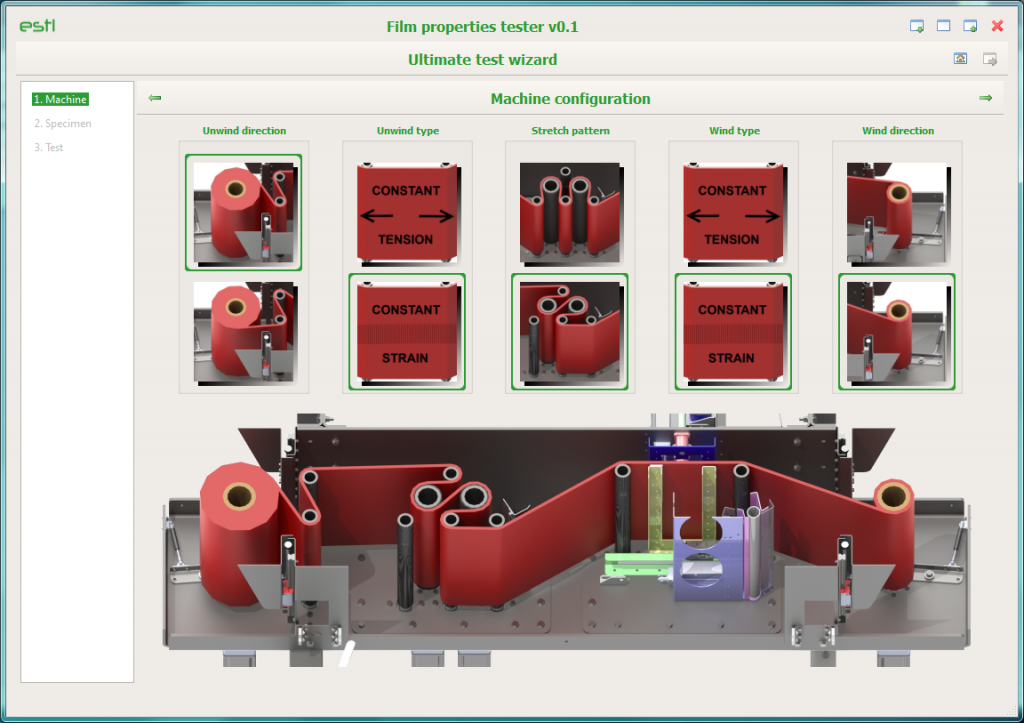
The machine is equipped with an intuitive touch screen control.
All tests are configured through a number of simple wizards. These wizards allow, for example, the selection of film type (inside / outside cling), type of film carriage (S or W), tension, test speeds...
Client software" is supplied with the machine. This software can be installed on the quality manager's computer, for example. In this way, results can be assessed 'offline' without losing valuable testing time.
Direct Measurement Technology
The force in the various sections is measured directly on the unwind, winding and pre-stretch axles. It was decided not to measure on the guide rollers.
This approach has ensured that the film can be tested in an S and W set-up. This allows different wrappers to be simulated.
In addition, this approach improves accuracy.
Peel angle
The unwinding properties of a stretch film are very important when this film is used in high-speed winding machines.
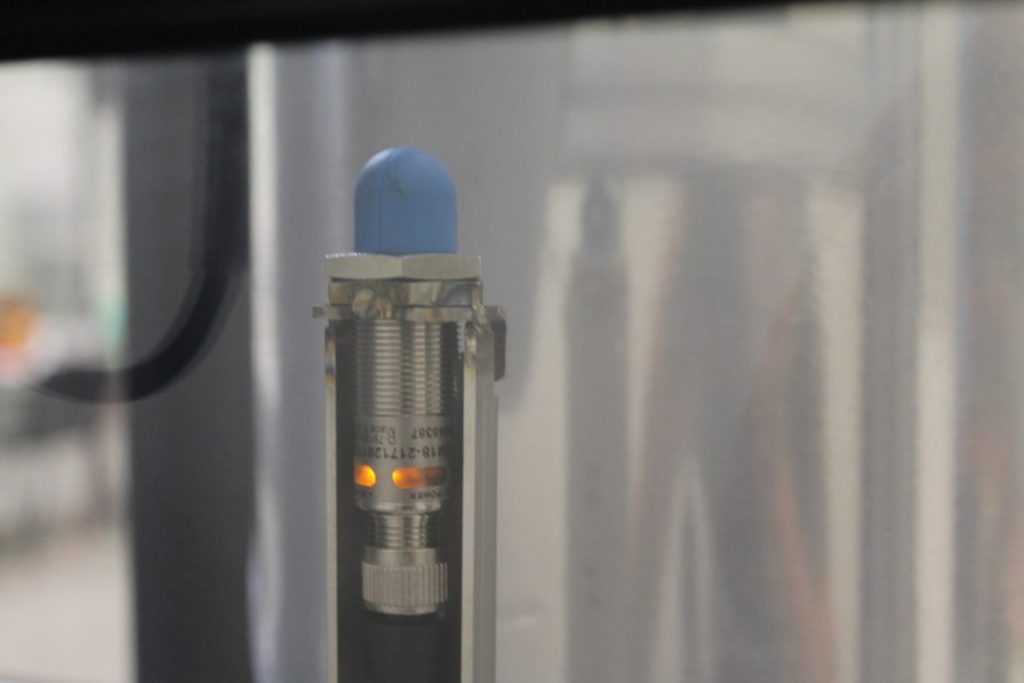
The unwinding quality can be defined by the unwinding point or the unwinding angle and its variation. Thanks to the detection of this point, the force required to pull the film off the roll can be calculated.
This strength is one of the main parameters for assessing the consistency of a production run.
Servo technology
The unwind, winding and both pre-stretch axes are equipped with powerful servo motors.
The application of servo technology allows full control of the test speeds. This also allows varying speed profiles - as they occur - to be simulated on the winder.
This simulation is made during the 'wrapper' and 'wrapper consistency ' test.
Puncture unit
The linear motion of the puncture (perforation) unit is driven by a servo motor.
The speed of the probe reaches a constant level just before impact. This speed can be set between 0 and 2000mm/s.
The probes can be easily exchanged without the use of tools.
Reliable cling test
To achieve a reliable cling test, all key operations are automated. This minimizes operator influence.
The cling - or adhesive strength can be measured at different pre-stretch and film tensions.
Multi-core clamp unit
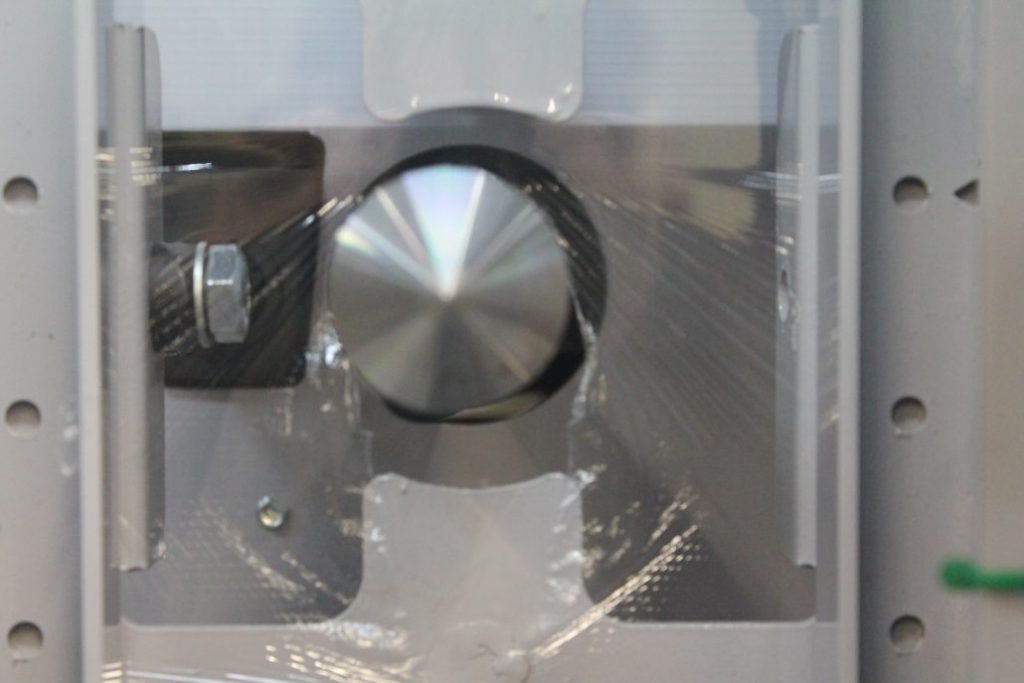
The automatic clamping device of the FPT-750 is designed for tubes of both machine and manual film.
The height of the foil (tube) may vary between 250 mm and 770 mm.
Exchange
The FPT-750 saves all data as standard in the specially developed *.fpt format. The data can also be exported to a Microsoft Excel® file.
In addition, the data can also be saved as a *.json file. This format can be easily read by third party software.
The FPT-750 communicates by means of json files with the FPM system installed by Windmöller & Hölscher on cast lines.
Neck-in measurement
Optionally, the FPT-750 can be equipped with a module that continuously measures the height of the film during an 'ultimate test'.
This allows the change in 'neck-in' to be measured as a function of front stretch.
Test programmes
Ultimate
Unwinding -, recovery -, peel off - and stretching force are measured as a function of front stretch.
The pre-stretch is increased to breaking point in predefined steps.
The test speed is constant and can be programmed between 0 and 4000 mm/s.
Consistency
A certain number of metres are brought to a predetermined pre-stretch. All this happens at a constant speed.
The forces in each section are laid out and tracked. Thus, statistical values can be kept of the following parameters: unwind -, reset -, peel off - and stretch force. Optionally, unwinding noise can also be recorded.
The speed of this test is adjustable between 0 and 4000mms.
Wrapper
In this test, the machine will continuously increase the front stretch. In this process, the unwind -, reset -, peel off - and stretch force are logged.
During this test, the machine uses a speed profile similar to the speed profile of a winder. Rotational speeds up to 50 rpm can be simulated.
The response delay of the winder can also be set.
Wrapper consistency
During the 'wrapper consistency test, a certain number of meters are pre-stretched to a predetermined pre-stretch.
The film is brought to this stretch at a varying speed. This speed profile corresponds to the speed profile on a winder.
The reaction time of the winder as well as the response delay can be set. This makes it possible to simulate real-life situations.
Puncture
The stretch film is pre-stretched and brought to a certain tension. Next, the foil is clamped by a canvas. Finally, the foil is perforated by a probe.
It comes standard with three different probes: puncture, dart and tear resistance.
The pre-stretch, tension and perforation speed can be programmed.
The software calculates the maximum force, travel of the probe (from first contact to break) and energy absorption.
Relaxation
The stretch film is pre-stretched and brought to a certain tension. Then the film line is stopped.
The change of forces in each segment is logged as a function of time.
Cling
The stretch film is wrapped around an ellipse in a controlled manner. The stretch and tension at which this takes place are adjustable.
A driven contract roller pushes away the air between the layers of film. One layer of film is then pulled away from the underlying layer.
The software calculates the maximum and median value of the force.
Tear Propagation
The film is stretched to the desired level of pre-stretch and second stretch. A small cut is made in the film. After this initial cut, additional forces are applied to the film until it fails.
The more force the film can withstand, the better the propagation properties.
Core brake
This is a special 'ultimate' test for hand wrapping film or 'core brake' film. It mimics the behavior of these applications.
The film is stretched by reducing the unwinding speed of the core.
Load retention
A sheet is pushed into a stretched piece of foil to check the carrying capacity of the foil.
The test is similar to the 'astm pull plate' test.
Cross stiffness
During this test, the film is placed in a specific condition of pre-stretch and tension. The line is stopped while the film remains under the proper conditions (under tension). The operator can now attach the lower and upper clamp to the film. Once finished, a vertical movement is applied to the film. In this way, the vertical tensile curve is measured
Sweep cycle
This test allows one to monitor the behavior of the film after stretching.
The pre-stretch remains constant while the winding tension is increased little by little until the film tears. Thus, the stiffness of two types of film can be compared.